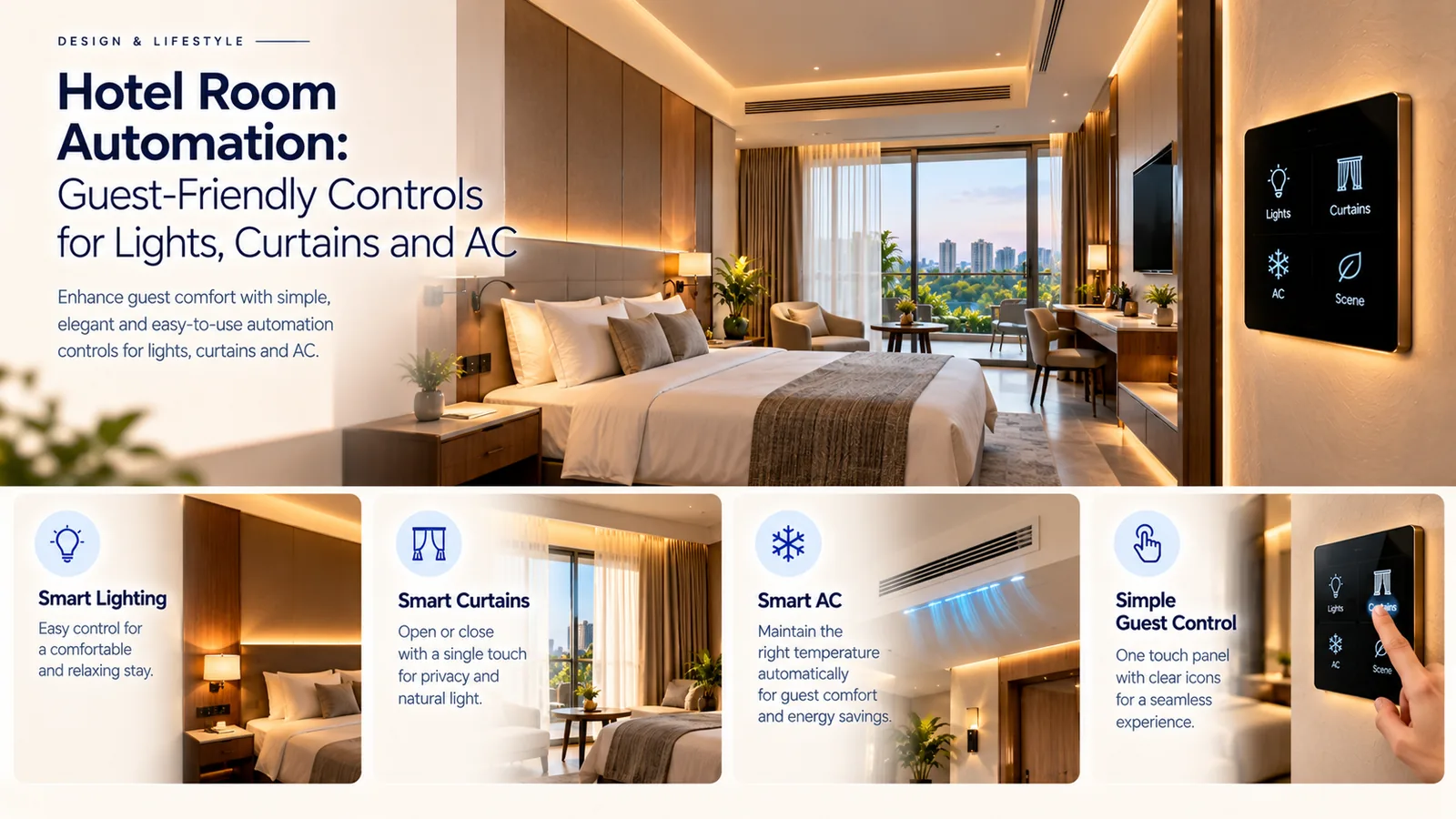
Hotel room automation gives guests simple, intuitive control of lights, curtains and AC, while helping owners save energy when rooms are empty. The goal is a room that feels premium and effortless, without confusing guests who are seeing the controls for the first time.
For hotels, resorts, serviced apartments and homestays across Tamil Nadu, from Chennai business hotels to hill and temple-town properties, here is what to include and how to design controls that guests actually enjoy.
Why Hotels Invest in Room Automation
- Guest experience: one-touch scenes like ‘Welcome’, ‘Sleep’ and ‘All Off’ feel modern and premium.
- Energy control: lights and AC can switch off or set back when the guest leaves the room.
- Consistency: every room behaves the same way, which reduces calls to the front desk.
- Operations: housekeeping and maintenance can work more efficiently with clear room status indicators.
Key Card and Occupancy-Based Energy Saving
The most common feature is a key card holder at the entrance. When the guest inserts the card, power to lights and AC is enabled and a welcome scene can run. When the card is removed, the room switches off after a short delay. Occupancy sensors can add another layer by detecting when the room is actually empty.
Designing Guest-Friendly Controls
Entrance panel
Near the door, a simple panel with ‘Master On/Off’ and corridor light. Guests should never have to hunt for a switch when they walk in with luggage.
Bedside panel
Controls for reading lights, room lights, curtains and ‘All Off’ within easy reach of the bed. Include Do Not Disturb and Make Up Room buttons where the property uses them.
Bathroom and wardrobe
Motion-triggered night lights in bathrooms and auto lights in wardrobes reduce fumbling in the dark.
- 1Label every button with a clear icon or word, in English and optionally Tamil.
- 2Use backlit panels that are visible in the dark but not glaring.
- 3Keep the same layout in every room category.
- 4Always provide a simple manual way to control lights and curtains.
- 5Test the room as a first-time guest before rolling out to all floors.
Curtain and AC Control in Hotel Rooms
Motorised curtains with sheer and blackout layers let guests open the view in the morning and darken the room for daytime sleep, which matters for business travellers and pilgrims arriving at odd hours. AC automation allows a welcome temperature, guest-adjustable limits and set-back when the room is empty.
| Standalone room controls | Centrally managed rooms | |
|---|---|---|
| Setup | Each room works independently | Rooms linked to a central system |
| Visibility for staff | Limited | Room status visible to management |
| Best suited to | Boutique hotels, homestays, small resorts | Larger hotels and serviced apartments |
| Network needs | Minimal | Reliable building-wide network |
Bathroom and balcony touches
Small details often shape a guest's opinion of the room. A dimmed path light that comes on when the guest gets up at night, a balcony light on the bedside panel, and curtains that close with the ‘Sleep’ scene all feel thoughtful without adding complexity. In coastal and hill properties, balcony fittings should have suitable IP ratings for rain and humidity.
Planning a Hotel Automation Project
- Decide the feature set per room category: standard, deluxe and suites can differ.
- Plan wiring during construction or renovation, room by room.
- Build a pilot room first and gather staff and guest feedback.
- Ensure backup power for critical systems; Tamil Nadu power cuts should not leave guests in the dark.
- Combine room automation with access control such as RFID cards, CCTV in common areas and boom barriers for parking where needed.
How Sensor Supports Hotel Room Automation
Sensor Home Automation offers hotel and office automation alongside smart lighting, curtain automation, touch panels, AC automation, RFID access, CCTV and boom barriers. For a hotel room automation project, the team starts with a free consultation and site visit, helps design room layouts and a pilot room, and carries out installation with its own team. After testing, staff are trained on the system, and Sensor provides ongoing support and maintenance. Contact +91 95975 75712 or support@sensorhomeautomation.in to discuss your property.
Frequently asked questions
What is hotel room automation?
It is a system that controls lights, curtains, AC and sometimes service requests from simple panels in the room. It usually includes a key card or occupancy feature that saves energy when guests are away.
Does hotel room automation save energy?
It helps reduce waste by switching off lights and setting back the AC when rooms are unoccupied. How much it saves depends on room usage, climate and the settings chosen.
Can existing hotel rooms be automated without major renovation?
Often yes, using retrofit modules and wireless curtain and AC controllers. The extent of work depends on existing wiring, so a site survey is the first step.
How do guests learn to use hotel room automation?
Good design means guests should not need instructions: clear labels, a master switch at the door and an obvious ‘All Off’ button by the bed. A small card in the room and a quick explanation at check-in help for features like curtains and scenes.
Is hotel automation suitable for small resorts and homestays?
Yes. Standalone room controls with key card switching and simple scenes suit boutique properties well, without needing a central management system.
Related service: Home Automation — see how Sensor plans, installs and supports it across Chennai, Salem and Tamil Nadu.


