When you weigh a sliding gate vs swing gate for automation, the short answer is this: a sliding gate suits tight driveways and sloping entrances, while a swing gate suits wide, level compounds where you want a classic look and simpler groundwork. The right choice depends less on style and more on your plot, the space beside and behind the gate, and how the entrance behaves in Chennai’s monsoon.
This guide walks through how each type works, where each one struggles, and the questions our team asks during a site visit before recommending either.
How sliding and swing gate automation work
Sliding gates
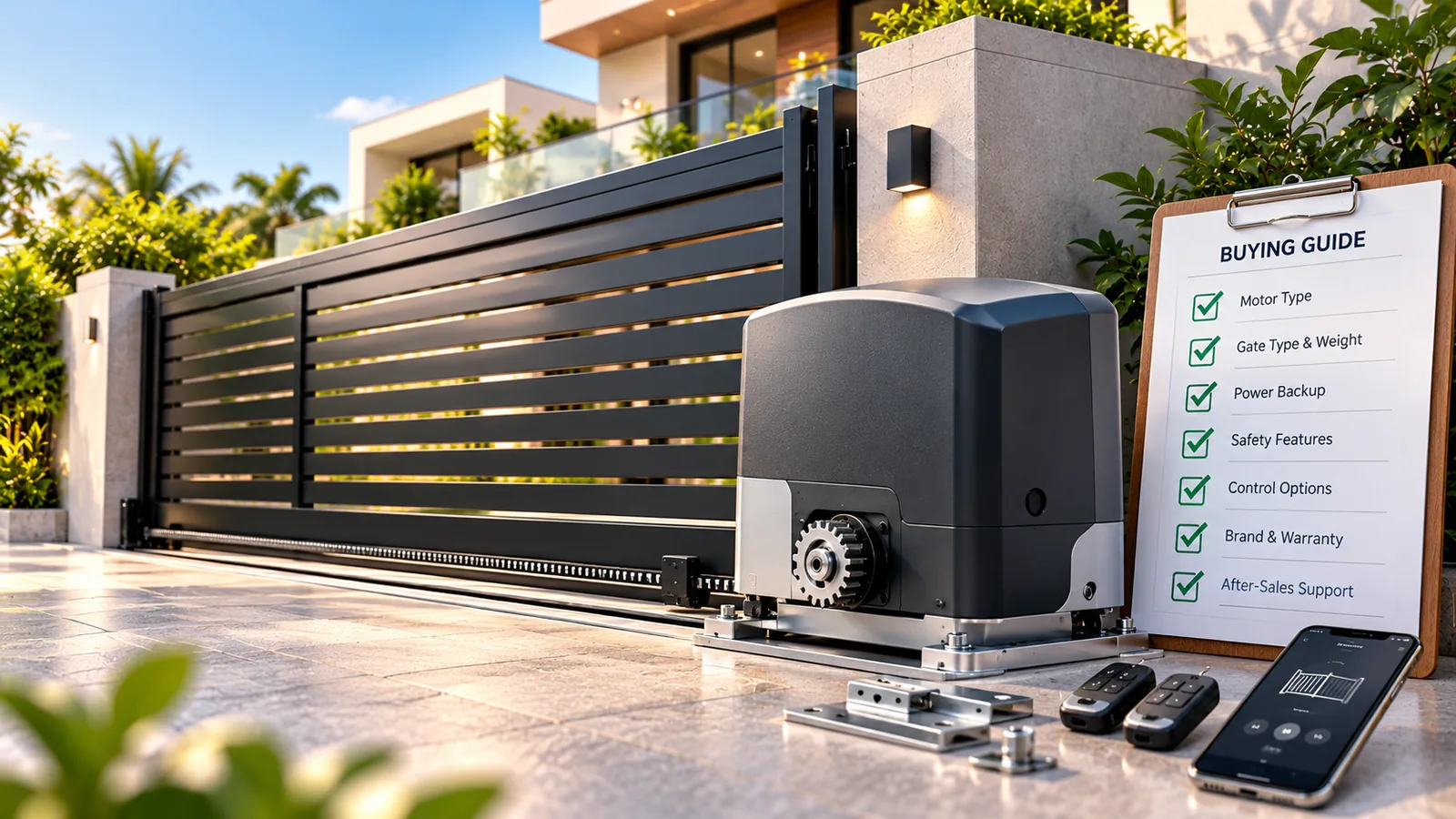
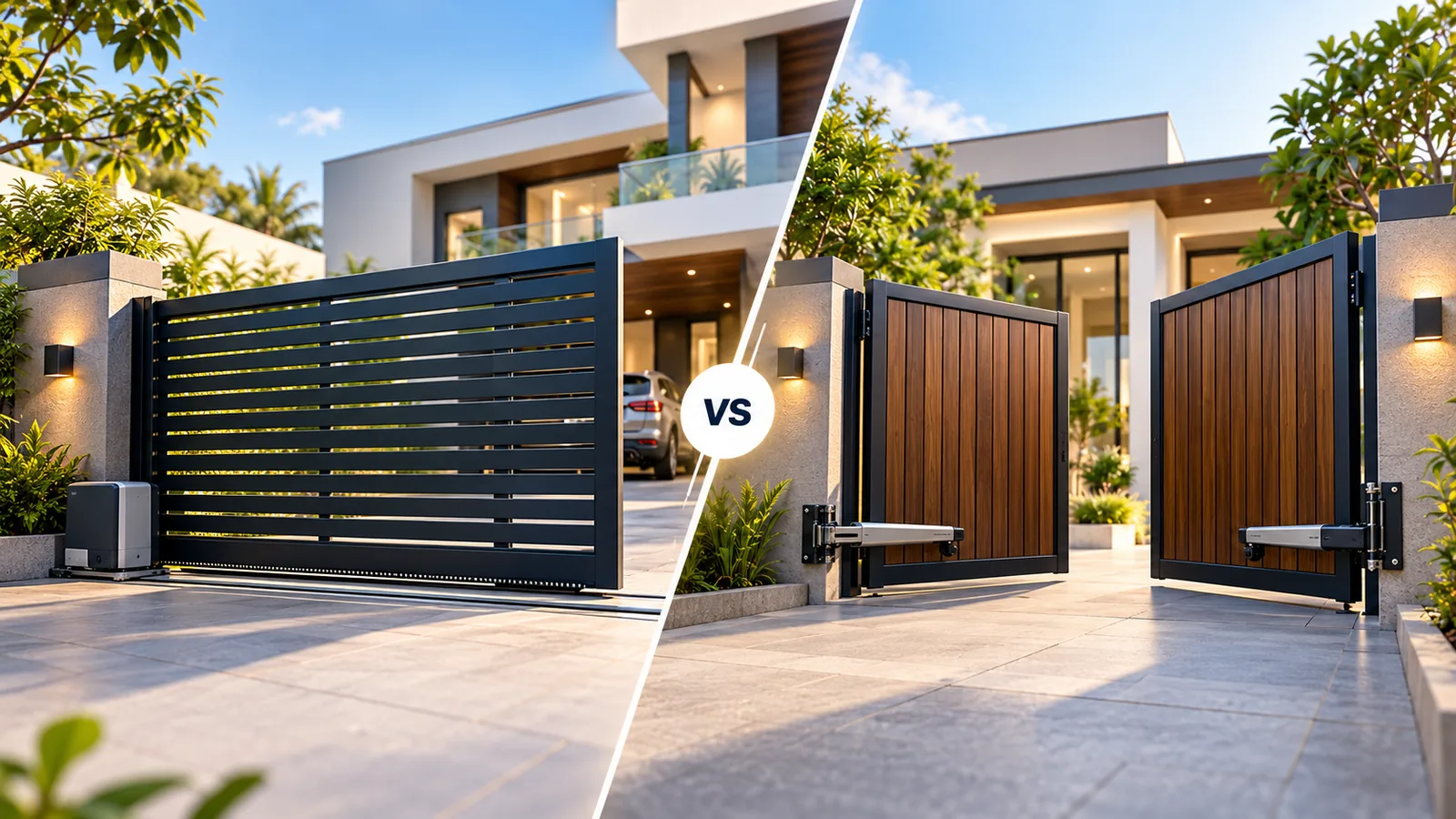
A sliding gate moves sideways along a ground track or on rollers. The motor sits on a concrete base beside the opening and drives a toothed rack fixed along the bottom of the gate — the familiar rack-and-pinion system. Because the gate travels parallel to the compound wall, it needs clear wall space roughly equal to the width of the opening, plus a little extra for the tail of the gate.
Swing gates
A swing gate opens like a door, usually as two leaves hinged at the pillars. Each leaf is moved by its own operator: either an articulated arm motor mounted on the pillar, a linear (telescopic) actuator, or an underground motor hidden below the hinge. The leaves need a clear arc inside the compound to open fully, which is the main constraint on smaller plots.
Space and plot layout: the deciding factor
In most Chennai homes the plot decides the gate before taste does. Narrow city plots with a car parked just inside the gate leave little room for leaves to swing. Conversely, a villa with a long frontage but a short side wall may not have space for a sliding gate to park when open.
- Measure the clear depth inside the gate: swing leaves need roughly the width of one leaf free of cars, pots and steps.
- Measure the wall length beside the opening: a sliding gate needs at least the full opening width to slide into.
- Check whether the driveway slopes up from the road; an uphill drive often blocks swing leaves from opening fully.
- Look at what is outside: if the gate opens onto a busy lane, an outward-swinging leaf is not an option.
| Sliding gate | Swing gate | |
|---|---|---|
| Space needed | Wall length beside the opening | Clear arc inside the compound |
| Sloping driveway | Handles slopes well | Leaves may scrape on uphill drives |
| Wind load | Low — gate stays in its own plane | Higher — large solid leaves act like sails |
| Groundwork | Concrete base and level track or rollers | Strong pillars; underground motors need a pit |
| Opening speed | Steady, single movement | Can feel faster for short leaves |
| Look | Modern, clean frontage | Classic, symmetrical entrance |
Monsoon, humidity and coastal air
Chennai’s rain is the factor most people forget. A sliding gate on a ground track can collect sand, leaves and silt, and in areas that waterlog during the north-east monsoon the track and the motor base can sit in water. The fix is a raised motor plinth, a proper drain near the track and regular cleaning — or a cantilever design that has no ground track at all.
Swing gates avoid the track problem, but underground motors are a poor choice in low-lying streets because the pit can flood. In those areas, pillar-mounted arm or linear operators are the safer option. Near the coast, salt air corrodes exposed steel quickly, so ask for galvanised or well-painted gate frames and motors with a suitable IP rating and corrosion-resistant housings.
Motors, power cuts and manual release
Both gate types are available with 230 V AC and 24 V DC motors. DC motors tend to offer soft start and soft stop, smoother obstacle detection and the option of a small battery backup, which matters when the power goes out. AC motors are rugged and common for heavy gates. Whichever you choose, the motor must be rated for the actual weight and length of your gate, with some margin.
- Battery backup or an inverter connection keeps the gate working during power cuts.
- Every automatic gate must have a manual release with a key, so you can open it by hand in an emergency.
- Limit switches (magnetic or mechanical) stop the gate at the correct open and closed positions.
Safety features to insist on
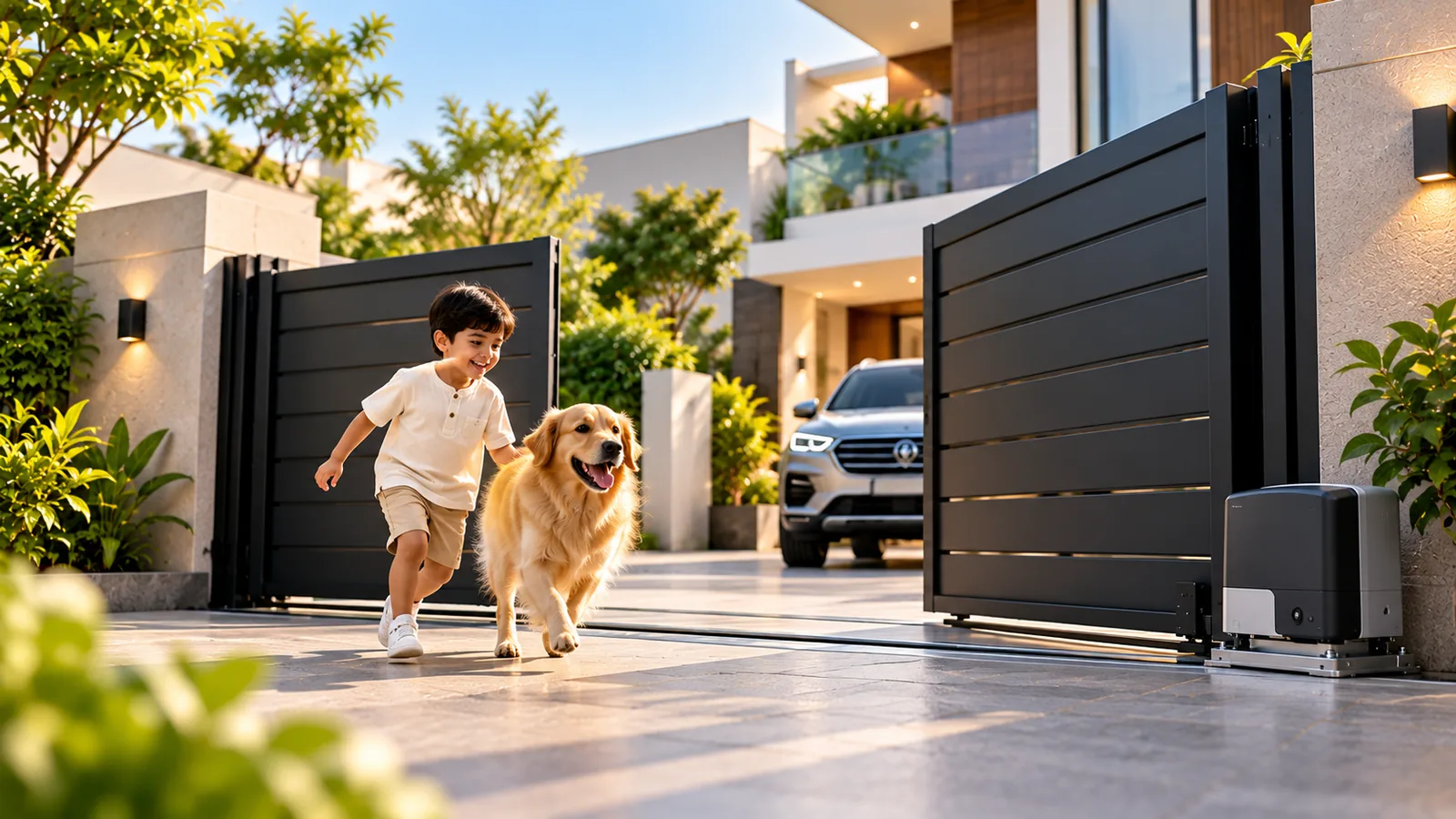
A heavy moving gate needs proper safety devices regardless of type. Photocell sensors across the opening stop and reverse the gate if a person, pet or car breaks the beam. Obstacle detection in the control board senses extra resistance and reverses. For sliding gates, a gap must be maintained at the open end to avoid trapping hands; for swing gates, the area around the hinge and the leaf edge needs attention.
Sliding gate vs swing gate: which should you choose?
- 1Choose a sliding gate if your driveway slopes, the inside space is tight, or the gate is very large and exposed to wind.
- 2Choose a swing gate if you have a level compound with clear space inside, want a traditional look, or lack wall length beside the opening.
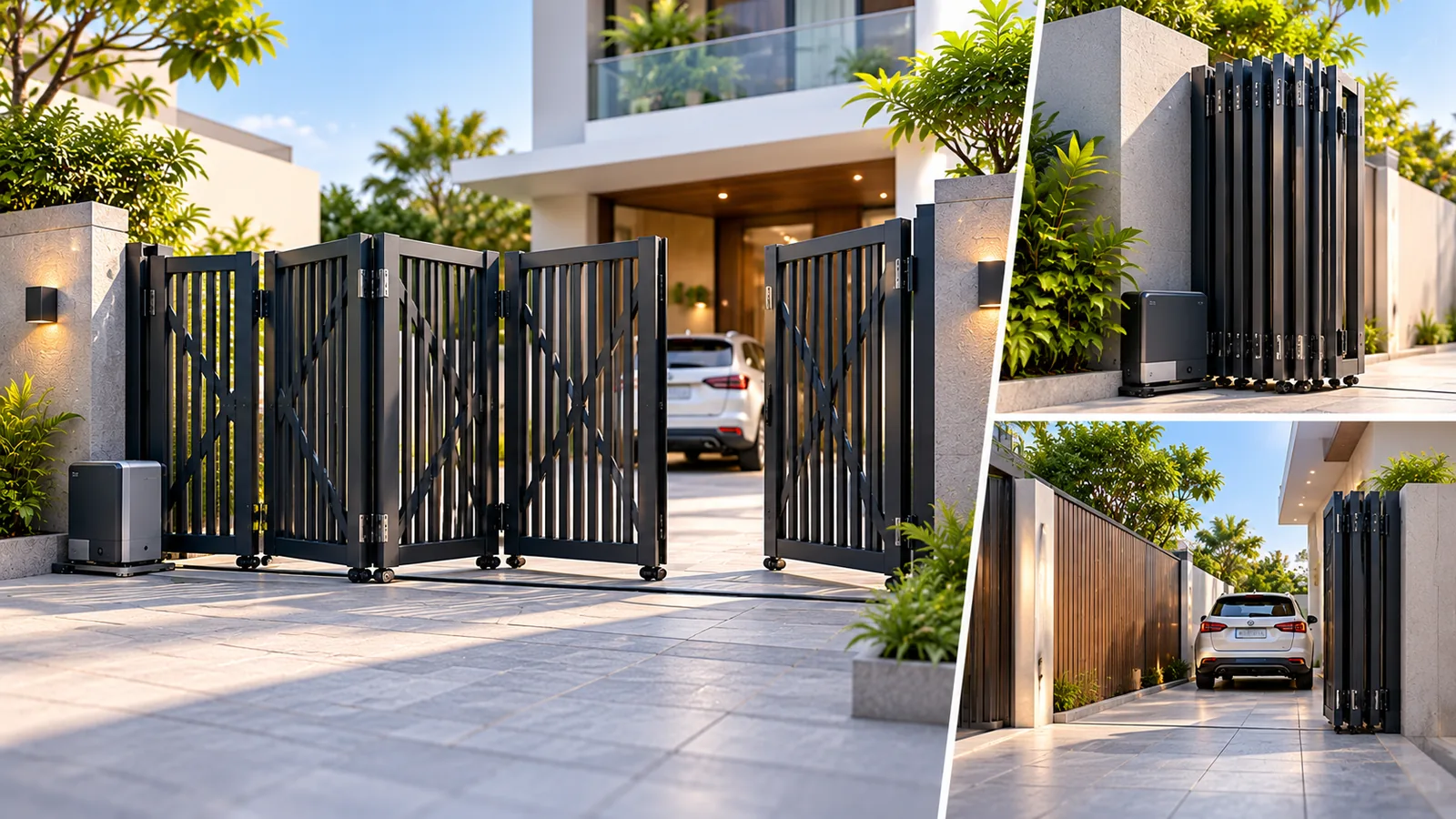
- 3Consider a foldable gate if neither fits — it needs less arc than a swing gate and less wall than a slider.
How Sensor helps you choose and install
The quickest way to settle the sliding gate vs swing gate question is a site visit. Sensor Home Automation offers a free consultation where our team measures the opening, checks the slope, drainage and power point, and recommends a gate type and motor matched to your gate’s weight. Installation, wiring, safety sensors and testing are handled by our own team, and we walk your family through daily use and manual release before handover, with ongoing support afterwards. We serve homes and businesses across Chennai, Salem and all 38 districts of Tamil Nadu.
Frequently asked questions
Is a sliding gate better than a swing gate for a small plot?
Usually yes. A sliding gate does not need any space inside the compound to open, so cars and steps can sit close to the gate. It does need wall length beside the opening, so measure that first.
Can I automate my existing swing or sliding gate?
In most cases, yes. A technician checks the gate’s weight, hinges or rollers and alignment. If the gate moves freely by hand, a suitable motor can usually be fitted without replacing the gate.
Which gate works better on a sloping driveway?
A sliding gate is generally the better choice because it moves parallel to the road and is not blocked by an uphill drive. Swing leaves on a slope may scrape the ground unless they are raised or modified.
What happens to an automatic gate during a power cut?
Gates with battery backup or an inverter connection keep working for a number of cycles. Every automatic gate also has a key-operated manual release so you can open it by hand.
Related service: Gate & Access Automation — see how Sensor plans, installs and supports it across Chennai, Salem and Tamil Nadu.